Sub-tropical humidity and proximity to the Mississippi River basin drive heavy commensal rodent pressure across East Baton Rouge Parish. In established neighborhoods like Spanish Town, Garden District, and Southdowns,…
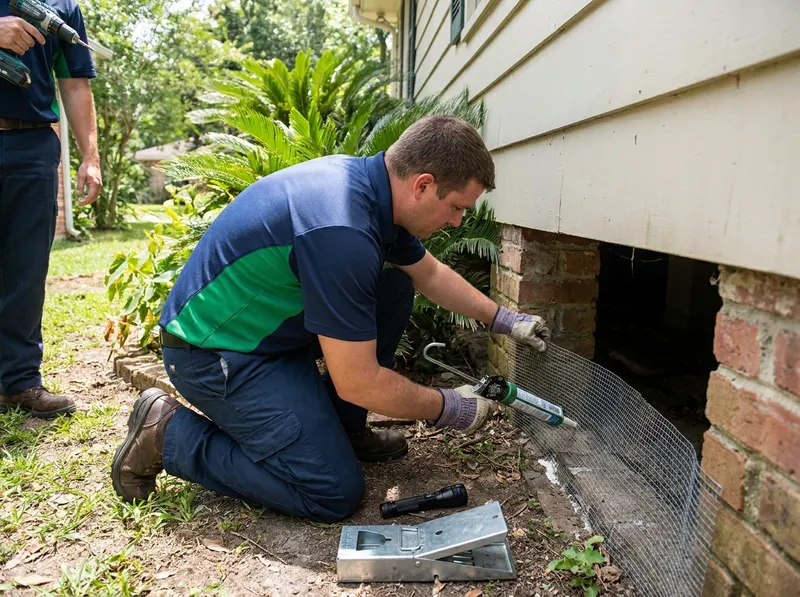
Sub-tropical humidity and proximity to the Mississippi River basin drive heavy commensal rodent pressure across East Baton Rouge Parish. In established neighborhoods like Spanish Town, Garden District, and Southdowns, Norway rats and roof rats exploit mature live oak canopies that touch historic rooflines, entering through unmeshed soffit vents, degraded fascia boards, and brick freeze voids. Farther east in slab-on-grade subdivisions like Shenandoah and Broadmoor, rodents frequently exploit weep holes, gable attic louvers, and unfinished utility chaseways behind exterior AC condenser lines. Rodents enter openings as small as 0.25 inches, the diameter of an ordinary pencil, to nest inside attic cellulose insulation and chew through electrical wiring, creating distinct fire risks and biohazard contamination from droppings.
Rodent trapping combined with structural exclusion solves the root structural vulnerability, whereas broadcast rodenticide bait stations merely cycle continuous waves of poisoned rodents that die inside wall voids. The trade-off between mechanical exclusion and chemical baiting is initial labor intensity versus long-term prevention. Trapping inside the thermal envelope relies on mechanical snap traps and multi-catch stations inspected every 48 to 72 hours; this guarantees dead rodents are removed immediately rather than left to decompose in southern Louisiana heat. Traps are monitored until activity ceases, verified through tracking powder and undisturbed sensor runs.
Physical exclusion work occurs simultaneously along the perimeter. Technicians install 0.25-inch, 19-gauge hot-dipped galvanized hardware cloth behind crawlspace grates, screw-fasten copper mesh into weep holes, and secure metal flashing over chewed wood transitions. Expanding foam alone is never used as an exclusion barrier because rodents gnaw through cured polyurethane within 48 hours; all sealants are metal-backed or elastomeric compounds embedded with stainless steel fiber. In elevated pier-and-beam properties throughout Spanish Town and Garden District, floor-wall transition voids beneath plumbing fixtures receive secondary wire mesh collars. For properties in Bocage and modern tracts, garage door sweep seals and HVAC wall penetrations receive heavy-gauge metal threshold plates.
Every job gets a firm, written price after a free on-site visit.
Tell us about your rodent trapping and structural exclusion job in Baton Rouge and we'll send a clear, written quote, usually the same day.
 Cazento Pest Defense